
When a financial trading platform executes decisions in microseconds, or a healthcare network analyzes patient data in real time, AI performance is no longer measured in benchmarks. It is measured in latency, uptime, and business impact. Even milliseconds of delay can change outcomes.
For organizations deploying AI in New York City, the question is not simply whether a data center is “AI-ready.” The question is whether it can function as an Edge AI accelerator, with the power density, cooling architecture, and interconnection required to support real-time inference at the urban edge.
Why New York Changes the Decision
In remote hyperscale regions, AI infrastructure decisions are defined by scale. In New York City, they are defined by constraint.
NYC is not a greenfield market. It is a dense, highly interconnected financial and media hub where infrastructure must operate within existing grid capacity, limited physical space, and established carrier hotel ecosystems. Space is finite. Power expansion requires utility coordination. And many legacy Manhattan facilities were never designed for sustained high-density AI workloads.
As AI moves into production, particularly inference-driven deployments, these realities start to dictate infrastructure decisions. In New York, choosing an AI data center is less about raw square footage and more about whether the facility was built to function as an Edge AI accelerator within the structural constraints of the city itself.
For infrastructure leaders, this means evaluating facilities through a different lens. The following criteria define what an Edge AI data center must deliver in NYC.
1. Sustained Power Density
The first filter for any Edge AI data center is power. But total facility power is only part of the story. What matters for AI deployment is sustained cabinet-level density that can be delivered without throttling, hot spots, or workaround configurations.
Traditional colocation environments were designed around racks drawing 4 to 8 kW. Modern GPU deployments routinely exceed 50 kW per cabinet, and in many cases far more. If a provider cannot support sustained high-density power, then Edge AI acceleration becomes theoretical. Infrastructure constraints will limit performance before software does.
2. Cooling Architecture Built for AI
At AI densities, cooling is not just a supporting system. It is a performance variable.
Inference workloads generate intense, continuous heat at the rack level. Room-based cooling systems were not built for this kind of sustained concentration.
A true Edge AI data center requires cooling architecture designed around how AI actually behaves:
- Airflow control through containment
- Localized cooling strategies
- Rack-level heat capture
Facilities retrofitted for AI may support limited high-density deployments, but scaling those environments often introduces instability. An Edge AI accelerator depends on predictable thermal performance under sustained load, not cooling systems stretched beyond their original design.
3. Interconnection as an Acceleration Layer
New York City’s data center landscape is shaped by legacy carrier hotel ecosystems. Many enterprises still rely on Manhattan facilities as their primary network node, even as space, cost, and physical scalability in those buildings become increasingly constrained.
For AI inference deployments, that network reality matters. A dense compute environment without direct access to diverse carriers, internet exchanges, and cloud on-ramps forces traffic into longer, more fragile paths. The result is increased latency and fewer options for redundancy.
Carrier-neutral interconnection environments collapse those pathways. They reduce hops, improve resilience, and allow AI deployments to operate closer to the networks and ecosystems they depend on.
4. Location and Speed to Deploy
Inference workloads are continuous and latency-sensitive. They must run close to users and business systems. In NYC, that means infrastructure within milliseconds of financial institutions, media networks, healthcare systems, and enterprise headquarters.
At the same time, AI deployment timelines move faster than utility upgrades. Many facilities cannot expand density quickly enough to meet demand.
Infrastructure leaders should evaluate not just what a provider can support eventually, but what it can support now, and how quickly high-density environments can be delivered on real deployment schedules.
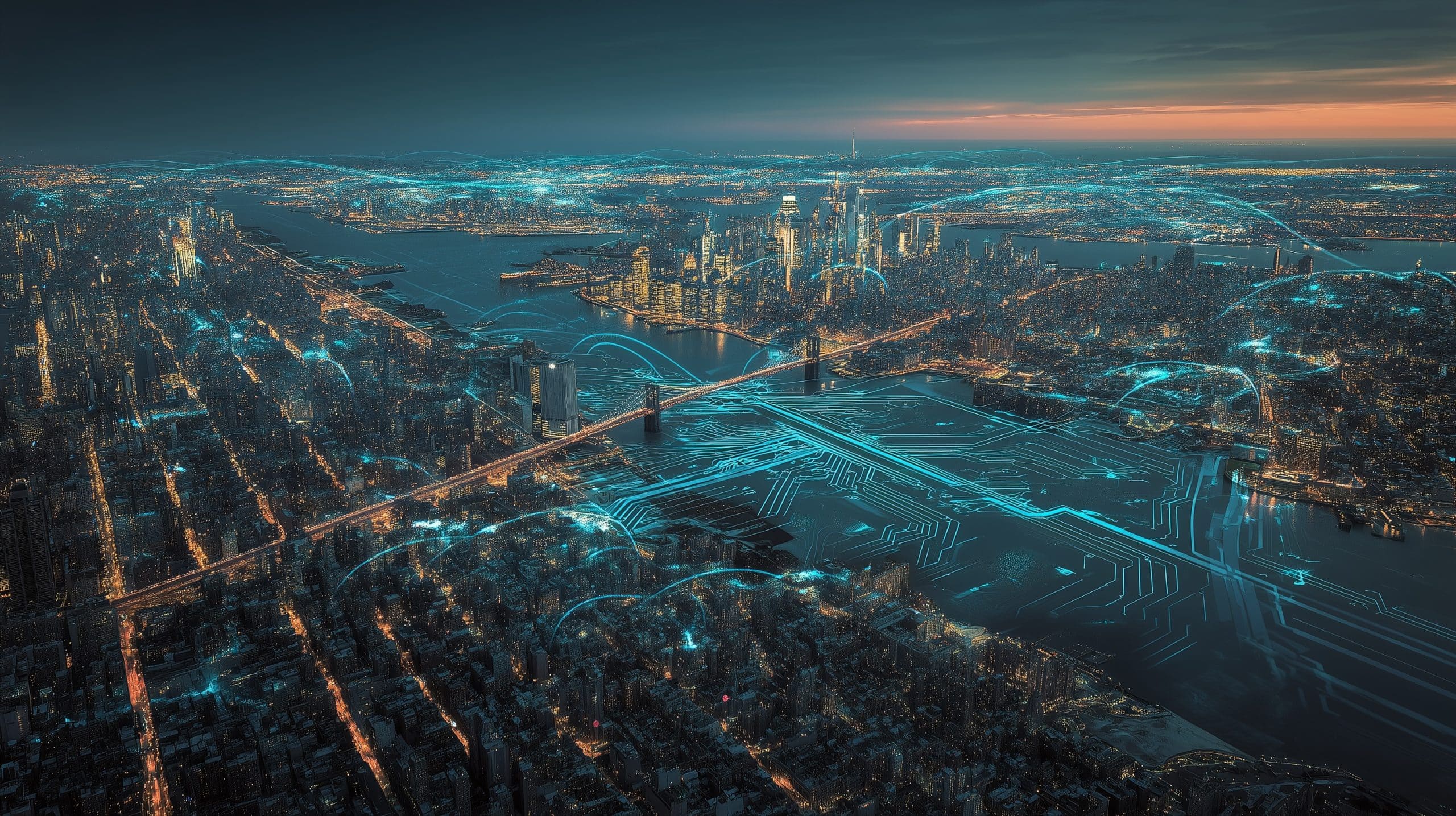
The Edge AI Data Center of NYC
The right Edge AI data center in NYC is not simply the largest facility. It is the one designed to function as an Edge AI accelerator: delivering sustained density, cooling architecture built for AI, deep interconnection, and proximity to the ecosystems where AI creates value.
This is the reality DataVerge is building for Industry City in Brooklyn. We’re bringing scalable high-density infrastructure and carrier-neutral interconnection together in the place where NYC’s AI workloads increasingly need to run.